

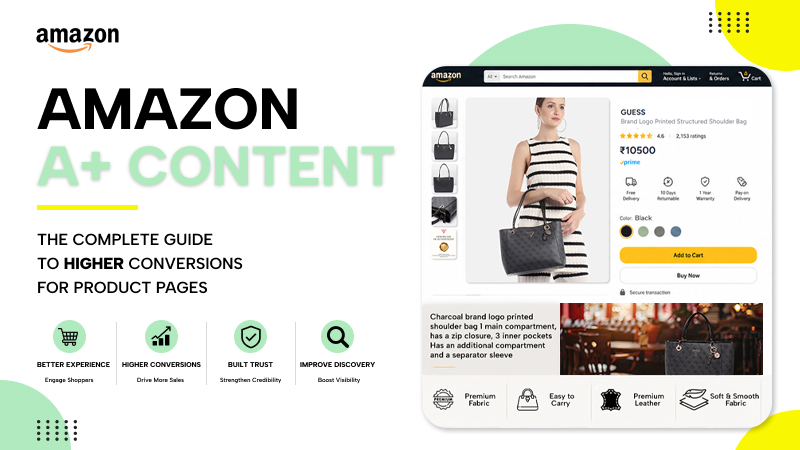
Amazon product pages are no longer competing on price alone. Shoppers compare visuals, evaluate brand credibility, and make decisions in seconds. All this is often done before they reach the bullet points.
That’s where Amazon A+ Content changes the experience. Instead of relying on standard descriptions, brands can use enhanced visuals, richer storytelling, comparison modules, and structured product information to help shoppers evaluate products with more confidence.
But creating A+ Content isn't just about making listings look better. The difference between average and high-performing content often comes down to how well each module supports discovery, product understanding, and conversion.
In this guide, we'll break down what Amazon A+ Content is, how it works, how Premium A+ differs, and the practices brands use to build stronger product pages.
Amazon A+ Content is a tool available to brand-registered sellers that replaces basic product descriptions with rich, visual content. Think lifestyle images, comparison charts, storytelling modules, benefit-focused copy, and interactive elements all sitting where a plain text description used to be.
In simple terms, A+ Content gives brands more control over how product information is presented and understood on Amazon.
So, what is Amazon A+ Content doing for your listing specifically?
It's giving shoppers more reasons to trust your brand, understand your product, and ultimately click Add to Cart. Brands using A+ Content consistently see significant conversion rate improvement as compared to standard listings.
Not all A+ Content is the same. There are two tiers, and understanding the difference matters before you decide where to invest.
Premium A+ becomes more valuable for brands with broader catalogues, stronger visual assets, or products that require more shopper education.
A+ Content does more than just look good. It shapes how shoppers experience your product page, and that ripples outward.
Here's what it actually influences.
A richer PDP experience. More context. More clarity. Shoppers get a fuller picture before they decide. That's the whole point of A+ Content.
Lower bounce risk. When a page answers questions clearly, shoppers stick around. They don't bounce off to compare somewhere else. Confusion sends people away. Clarity keeps them on the page.
Stronger branded searches. Good A+ Content builds recognition. Shoppers remember your brand, and they search for it directly next time. That's a compounding effect over time.
Amazon discoverability. A+ Content supports how your listing performs within Amazon itself. Better engagement signals, better time on page, and stronger conversion all feed back into how Amazon's own algorithm treats your listing.
Consistency across channels. Your A+ Content reflects your brand everywhere. If shoppers see your product elsewhere first, a consistent PDP experience builds trust when they land on Amazon.
Worth being clear here. A+ Content isn't a shortcut to ranking higher on Google. It won't guarantee external search traffic. What it does is strengthen the experience once someone's already looking at your listing, on Amazon or off it.
These aren't generic tips. These are the practices that consistently separate high-performing A+ Content from listings that underdeliver:
Your first module should show your product in real use. Aspirational, relatable imagery tells a story before a word is read. Specs belong further down after trust is established.
Each module should communicate one idea. Don't cram benefits, features, and social proof into the same block. Clarity converts. Clutter confuses.
Over 60% of Amazon traffic comes from mobile users. Add text overlays to images for small-screen readability. Keep text blocks under 500 words. Use bold key phrases that stand out without requiring a zoom. Test on an actual mobile device before publishing, not just the desktop preview.
Comparison charts are one of the highest-converting A+ modules available. Use them to cross-sell related ASINs from your catalogue. Help shoppers find the right variant rather than leaving the page to search again.
Pull from your Q&A section and competitor listings. The questions buyers ask before purchasing are the exact objections your A+ Content should address. Answering them inside the page removes friction at the most critical moment.
Mismatched layouts, inconsistent image sizes, and formatting gaps signal low quality to shoppers. Consistency builds trust. Every module should feel like it belongs to the same brand story.
Amazon's built-in analytics in Seller Central show conversion rates, page views, and module engagement. Check weekly. Identify which modules drive value and which need work. The best A+ Content evolves it doesn't sit static after publishing.
Looking at strong A+ content, Amazon examples reveal a consistent three-part structure:
Part 1: Hook with lifestyle imagery. Lead with an aspirational image that shows the outcome the shopper wants, not just the product itself. This is the emotional entry point.
Part 2: Prove with benefits. Shift to benefit-focused copy and supporting visuals that explain why your product delivers the outcome shown in Part 1. Address real concerns. Use social proof.
Part 3: Close with credibility. End with brand story, awards, reviews, or certifications. This is where trust gets consolidated before the shopper makes a decision.
Amazon Premium A+ content examples from top brands add interactive elements, hover hotspots that reveal additional detail, video modules that demonstrate product use, and expanded layouts that turn the listing into a genuine brand experience.
Amazon A+ Content is one of the few Amazon optimisations that improves both product understanding and buyer confidence at the same time. When shoppers find answers directly on the product page, they spend less time comparing and more time making decisions.
The brands seeing stronger PDP performance are not treating A+ Content as a one-time upload. They refresh modules, test layouts, adapt to customer behaviour, and continuously improve how products are presented.
For brands looking to build richer and more scalable product experiences, investing in Amazon A+ content services can help create product pages that stay useful long after they go live.
Tell us what you're working on and we'll get back to you with ideas and next steps.


Amazon A+ Content is premium brand content that replaces basic product descriptions with visuals, comparison charts, and storytelling modules. Only sellers enrolled in Amazon Brand Registry can access it. Standard A+ is free. Premium A+ requires additional approval and eligibility criteria beyond standard Brand Registry access.
A+ Content improves conversions by helping shoppers understand products faster through stronger visuals, clearer benefit communication, comparison modules, and richer product context. It reduces uncertainty and helps buyers make decisions with more confidence.
Update it every few months, or whenever something changes. New features, new variants, or shifts in what customers ask about all count. Stale content loses trust fast. If reviews mention confusion, that's your cue to refresh.
Templates make this manageable. Build a modular structure first. Reuse layouts, but swap in product-specific details. Batch your photography too. Shoot similar products together. This keeps quality consistent without redoing everything from scratch each time.
Common mistakes include overcrowding modules, repeating product descriptions, using weak visuals, ignoring mobile readability, and publishing static content without testing performance or updating based on shopper behaviour.
Brands usually benefit from Amazon A+ content services when managing large catalogues, launching frequently, or struggling with inconsistent PDP performance. Structured production workflows help maintain content quality while improving speed and scalability.

.png)


