

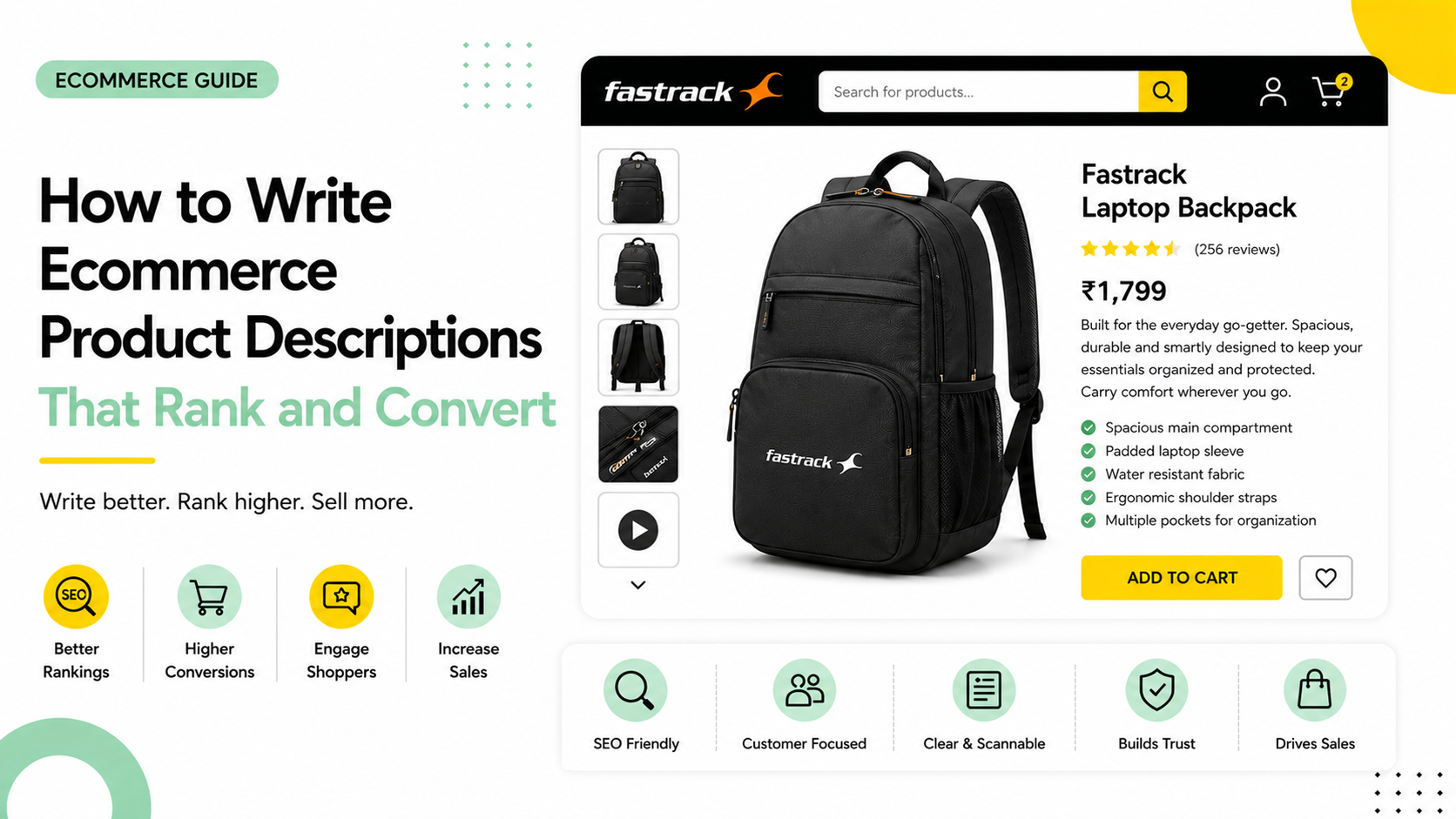
Staring at a blank product page, cursor blinking, unsure whether to lead with specs or benefits or if anyone will even read past line one? You're not alone. This post breaks down what a product description is actually meant to do, the SEO fundamentals behind discovery, and the habits that turn visits into sales.
Product descriptions aren't just information dumps. They're persuasion tools that also need to satisfy search engines. Balancing both is where most sellers get stuck.
By the end, you'll have a clear, repeatable process for writing descriptions yourself or briefing someone else to do it right.
In ecommerce, a product description is the block of copy that explains what you're selling, why it matters, and why someone should buy it from you rather than scroll past.
That's the simplest product description definition in ecommerce terms but the good ones do more than describe. They persuade, reassure, and answer the exact question a shopper is silently asking: "Is this right for me?"
You might assume shoppers barely read product descriptions. The data says otherwise. According to a Retail TouchPoints survey of 1,000 US consumers, accurate product content influences 87% of shoppers' purchase decisions. Also, 50% of shoppers say they've returned an item because it didn't match the description.
Your product photographs are always the hook. AI product photography makes sure that hook lands fast, but your product descriptions are what make or break the final buying decision. If a buyer can't find the specific detail they came looking for, they won't dig for it. They'll just move on.
A few habits separate product descriptions that convert from ones that just take up space:
Following these best practices consistently across hundreds or thousands of SKUs can be challenging, especially for growing brands.
That's why many ecommerce businesses invest in product content optimization. It ensures every product page is search-friendly, accurate, and written to convert while maintaining consistency across their entire catalog.
When you sit down to do e-commerce product description writing, this order tends to work well:
"Identify what genuinely sets the product apart, not the spec sheet itself, but what each spec actually means for the buyer."
A great ecommerce product description isn't longer, cleverer, or more "salesy" than a weak one; it's just more specific. It answers a real question, in the shopper's own language, and gives search engines enough structure to actually surface it.
Get those two things right consistently, and your product pages start doing the selling for you, instead of just sitting there describing.
Tell us what you're working on and we'll get back to you with ideas and next steps.


They're often used interchangeably, but "product description" usually refers to the dedicated description block, while "product copy" can include titles, bullets, and A+ content too.
Long enough to answer real objections, short enough to stay scannable, often 100,300 words for most categories, more for complex or high-consideration products.
No. It reads poorly to shoppers and can hurt rankings; natural keyword placement performs better long-term.
Ideally, yes. Even small differences in colour, size range, and material are worth reflecting in the copy, since duplicate descriptions across variants can dilute search visibility.
Not as separate versions, but they should be written mobile-first: short sentences, scannable bullets, and the key benefit visible without much scrolling, since most shoppers are browsing on a phone.
Whenever something changes, such as new features, recurring review confusion, or a competitor raising the bar, rather than treating them as a one-time task finished at launch.

.png)


