

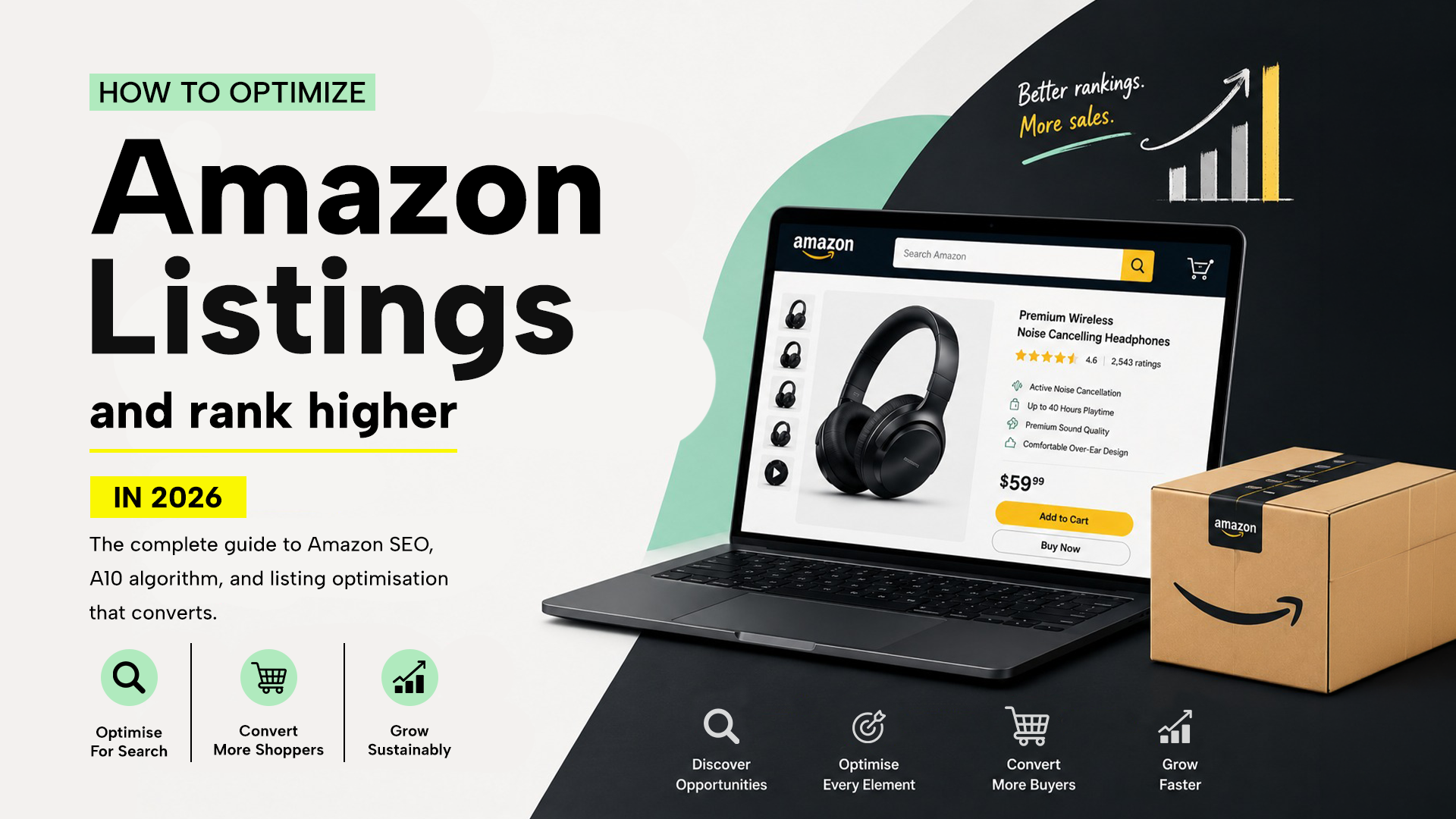
Amazon listing optimisation is no longer about adding keywords and uploading a few images. In 2026, rankings and conversions depend on how well your product page helps customers understand, evaluate, and trust what they’re buying.
Many sellers invest heavily in inventory and advertising, but overlook the listing itself. As a result, traffic arrives, but sales don’t follow.
Amazon listing optimisation brings together product titles, visuals, keywords, A+ content, and page structure to improve discoverability and conversion. This guide explains what matters most and how brands can build listings that perform consistently at scale.
Let's start with the uncomfortable truth. Most brands are still optimising for 2022.
Amazon search engine optimisation isn't what it used to be. Keyword stuffing. Generic bullet points. A main image with a white background and nothing else. These tactics used to work. Today, Amazon's algorithm has moved far beyond them.
Amazon's search algorithm now weighs dozens of behavioural signals invisible in third-party tools, prioritises visual engagement over text-heavy listings, and factors paid advertising performance into organic visibility. The platform has fundamentally changed, and most sellers haven't caught up.
You've probably heard of Amazon's A9 algorithm. In 2026, the A10 update has shifted the game significantly.
The A10 algorithm shifts focus toward "Customer Authority" and "Organic Sales Velocity." It weighs external traffic from social media and blogs and organic performance more heavily than internal PPC spend.
In simple terms? Amazon rewards listings that earn genuine buyer trust. Not just listings that throw money at sponsored ads.
Key ranking factors include click-through rate, conversion rate, consistency in sales velocity, inventory stability, pricing behaviour, and overall buyer response compared to competing listings. Every single signal points back to one thing: how buyers respond to your listing.
If you're wondering how to optimise your Amazon listing in 2026, it starts here. Six core elements determine whether your listing ranks, converts, and scales or sits invisible on page four.
Your title is doing two jobs simultaneously: ranking and converting. Get it wrong, and you lose on both fronts.
In 2026, optimise your title for a dual audience: AI and humans. Include your primary keywords, clearly state the core product and its main benefit, and keep it highly readable. Avoid keyword stuffing. Amazon's AI can detect and penalise unnatural phrasing.
A strong title = higher click-through rate = better organic ranking. It's a direct chain.
You cannot optimise what you haven't identified. Keyword research isn't a one-time task; it's an ongoing optimisation process. To truly optimise your Amazon listing, you need to know exactly which terms your buyers are using before you write a single word of copy.
Successful sellers focus on a three-tier keyword approach: seed keywords (broad terms), competitor keywords uncovered through reverse ASIN lookup, and long-tail keywords targeting niche buyer intent.
Backend search terms still matter too. Fill every character of your backend field with relevant, non-repeated keywords that your title and bullets couldn't include.
Most bullet points list what a product is. The best ones communicate what a product does for you.
Think about what your buyer is actually worried about before purchasing. Answer that worry directly. Lead with the benefit, back it with a feature. Keep sentences tight. Keep language active.
Product titles, bullet points, descriptions, backend search terms, structured attributes, category placement, and brand information all contribute to relevance. If your listing isn't relevant enough, it will never have a real chance to rank.
Here's something most brands underestimate. Your images convert or they don't. Everything else is secondary.
Mobile shopping accounts for 63% of all e-commerce sales. Your visuals must be compelling and informative on smaller screens. Main images must be clean and instantly recognisable, especially for visual search.
You need a minimum of seven images: main shot, multiple angles, lifestyle context, scale reference, infographic, and a comparison or benefit callout. Videos push conversion even further.
If you have Brand Registry, A+ content is no longer optional. It's one of the strongest conversion tools on your listing.
Well-built A+ content answers objections before the buyer raises them. It tells your brand story. It shows the product in real-life contexts. It builds the kind of trust that pushes hesitant shoppers into the add-to-cart button.
Think of A+ content as your listing's closing argument. Make it count.
Amazon's algorithm treats your reviews as a performance signal, not just social proof.
Customer reviews remain one of the most powerful ranking factors on Amazon. The entire ecosystem of customer interaction serves as a powerful signal to Amazon's AI.
Respond to negative reviews professionally. Follow up on orders with compliant review requests. Actively manage your seller feedback score. Customer feedback influences trust and overall listing performance
Amazon continues to prioritise listings that create stronger customer engagement and purchasing outcomes.
That means optimisation can no longer focus on keywords alone. Listings need clear titles, strong visuals, informative bullet points, and complete product information. Together, these elements help shoppers evaluate products faster and buy with confidence.
External traffic can support discovery, but listing quality remains the foundation. If shoppers arrive and do not engage or convert, visibility becomes difficult to sustain
You might be making some of these right now and not even know it.
Amazon listing optimisation is not a copywriting exercise or a keyword exercise alone. It requires coordinated content production across visuals, product information, and platform requirements.
As an ecommerce content agency, ODN supports brands by building marketplace-ready product content systems designed for scale. Using structured workflows and AI-assisted production processes, we transform raw product catalogues into optimised listing assets across marketplaces.
From product imagery and infographics to A+ content, enhanced visuals, and structured listing content, every asset is built to improve product clarity and support faster go-live cycles.
With experience managing large-scale catalogues across multiple marketplaces, we help brands maintain consistency, reduce content bottlenecks, and create stronger product experiences at scale.
This is the mindset shift that separates brands growing on Amazon from the ones stagnating. Amazon listing optimisation isn't something you do at launch and forget; it's an ongoing performance discipline.
Your listing isn't a brochure you print once and file away. It's a living performance asset that needs continuous testing, updating, and optimisation based on real data search query reports, conversion metrics, return reasons, and competitor movement.
The brands winning on Amazon in 2026 treat listing optimisation as an ongoing system, not a launch checklist. They test new images. They refresh the copy based on search term data. They update A+ content as their product range evolves.
That's not just good SEO. That's a sustainable competitive advantage.
Amazon is the world's largest product search engine. And like any search engine, it rewards the listings that are most relevant, most trustworthy, and most likely to convert.
Strong products perform better when supported by clear, conversion-focused listings.
Invest in your listing the way you invest in your product. Build it with the right keywords, the right visuals, the right content structure, and a partner who understands what it takes to win on the platform in 2026.
That's exactly what ODN does for brands that are serious about Amazon.
Tell us what you're working on and we'll get back to you with ideas and next steps.


It's the process of improving every element of your product page title, keywords, images, bullet points, and A+ content so Amazon ranks your listing higher and more shoppers convert when they land on it.
Amazon's updated ranking system that weighs organic sales velocity, external traffic quality, and buyer behaviour signals more heavily than keyword placement or PPC spend alone.
At least seven main images, multiple angles, lifestyle context, infographic, scale reference, and ideally a short video. Mobile shoppers need visual confidence before they buy.
Meaningful ranking momentum typically develops over several weeks to a few months, depending on category competition and listing strength. Conversion improvements from better content can show up much faster.
6. Platform requirements, algorithm updates, image specifications, and A+ content standards change constantly. An experienced agency like ODN brings the expertise, production infrastructure, and data-driven approach to build listings that rank and convert consistently.
Brands should optimise both. Existing listings often already have traffic and customer data that reveal improvement opportunities faster. Updating titles, images, A+ content, and keywords on established listings can improve visibility and conversions without launching new products.

.png)


