

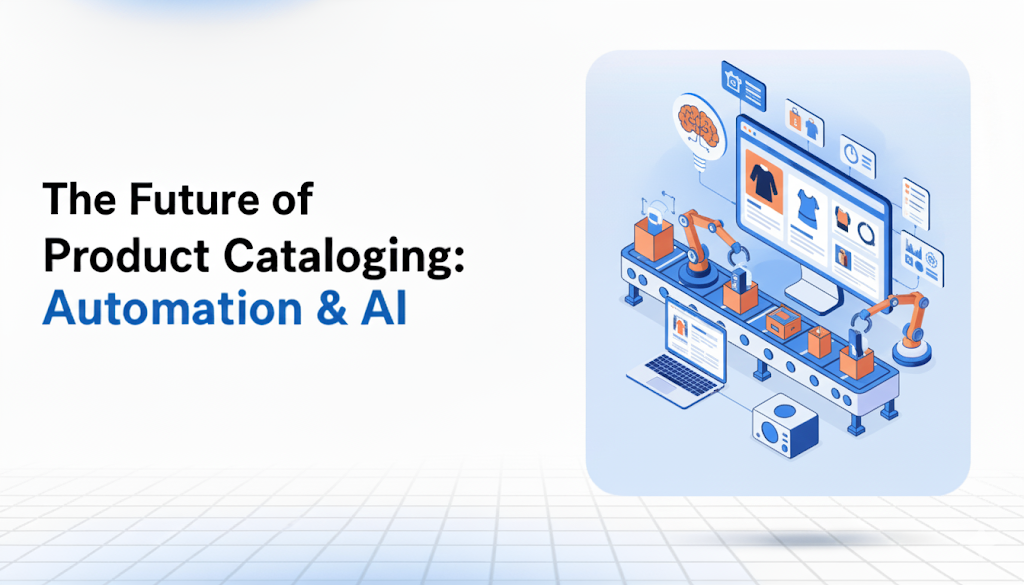
In ecommerce, a product catalog isn’t just a database, it’s the digital storefront customers interact with before making a purchase. But as product lines grow and online marketplaces multiply, managing catalogs manually becomes inefficient and error-prone. That’s why businesses are increasingly turning to AI catalog automation.
AI is no longer just a buzzword; it’s actively reshaping how product data is created, enriched, and delivered across platforms. If you’d like a deeper look at how AI has already changed catalog workflows, check out our insights on AI’s impact on catalog content. That article explores the current state, while this one looks at the future.
Manual cataloging creates bottlenecks that limit growth:
These challenges highlight why ecommerce brands must adopt smarter cataloging strategies.
AI catalog automation brings efficiency and accuracy into catalog management. Instead of relying on human input for every product detail, AI systems can:
By minimizing human errors and speeding up workflows, AI allows businesses to focus more on strategy and customer experience.
Scaling catalogs manually is unsustainable. Automated product listing for ecommerce helps retailers:
This shift from manual to automated cataloging ensures that businesses can grow without being held back by operational inefficiencies.
The next stage isn’t just automation, it's intelligence. Modern cataloging tools with AI offer features such as:
These tools don’t just speed up cataloging; they actively enhance the customer journey and drive conversions.
The future of ecommerce won’t just be about larger catalogs — it will be about smarter catalogs. Businesses adopting AI will enjoy:
Simply put, AI ensures that catalogs grow intelligently rather than chaotically
As customer expectations rise, outdated cataloging processes will only hold brands back. AI catalog automation, automated product listing for ecommerce, and cataloging tools with AI are no longer optional add-ons, they’re critical for survival in competitive markets.
If you’re ready to explore how these innovations can transform your business, take a closer look at our AI-driven cataloging solution for ecommerce. It’s designed to simplify catalog management, improve customer experiences, and future-proof your digital storefront.
Tell us what you're working on and we'll get back to you with ideas and next steps.


AI catalog automation is the use of artificial intelligence to streamline catalog management processes like product categorization, description generation, and image tagging. It reduces manual effort and improves accuracy.
Automated product listing allows retailers to upload and update products across multiple platforms instantly, ensuring consistency, reducing errors, and speeding up go-to-market timelines.
Yes. Many AI cataloging tools are scalable, meaning small businesses can start with basic features and expand as they grow. This helps even smaller retailers maintain professional, optimized catalogs.
AI-driven cataloging solutions not only automate repetitive tasks but also provide intelligence, such as predictive analytics, personalization, and SEO optimization, giving businesses a competitive edge.
Yes. By ensuring product descriptions, images, and attributes are accurate and complete from the start, AI reduces the mismatched expectations that often lead to returns.
Most modern AI cataloging tools are built with API-first architecture, making integration with platforms like Amazon, Shopify, and Magento straightforward — typically requiring minimal technical overhead compared to legacy systems.

.png)


