

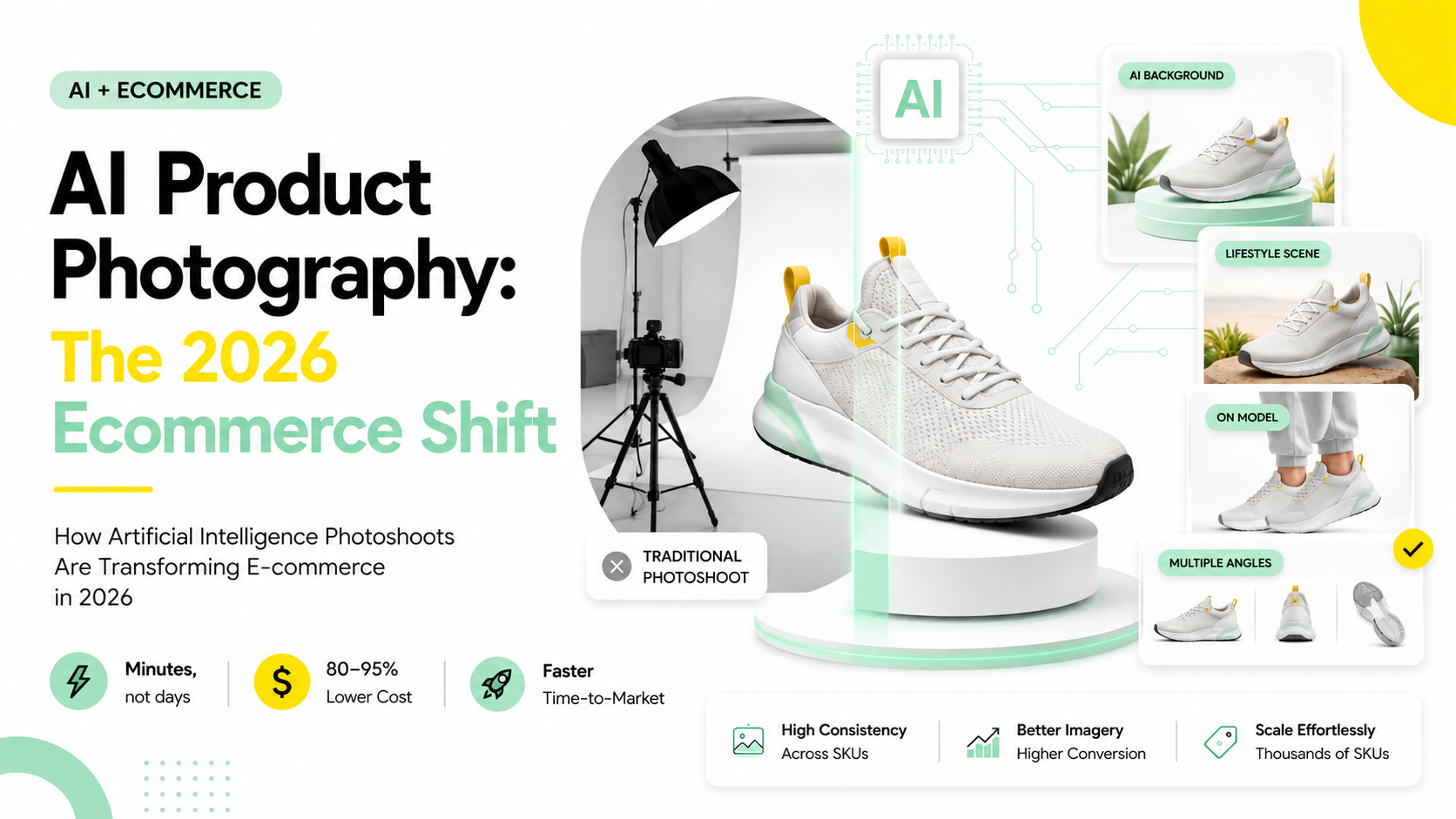
If you've ever delayed a launch because the photoshoot wasn't ready, this one's for you. Product photography used to mean booking a studio, waiting a week, and hoping the images turned out right. In 2026, a growing share of ecommerce brands are skipping that step entirely, turning to AI product photography instead.
This post breaks down what an artificial intelligence photoshoot actually involves, why AI-based product photography has become standard practice this year, and what it means for your costs, timelines, and conversion rates with real numbers, not hype.
An artificial intelligence photoshoot uses AI tools instead of (or alongside) a physical studio to produce product images, removing backgrounds, generating lifestyle scenes, placing products on virtual models, and creating marketplace-ready visuals in minutes rather than days.
It's not one single tool; it's a category of AI product photography software that has replaced a large chunk of what used to require a camera, a studio, and a crew. This is what's driving AI product photography for ecommerce brands to move faster, and why product photography AI platforms are increasingly treated as standard infrastructure rather than a novelty a shift often described simply as AI-based product photography
You don't have to take this on faith; the economics are the whole story. According to a 2026 ecommerce industry guide from Digital Applied, traditional product photoshoots typically run $200 to $5,000 per session, while comparable AI-generated images cost roughly $0.10 to $2.00 each, a reduction of 80–95% per image.
I'm using this particular figure because it gives a specific dollar range on both sides of the comparison. You don’t get a vague "AI saves money" claim. Also, it comes from an industry guide tracking actual tool pricing rather than a single vendor promoting its own product.
A lot of the AI photography stats circulating right now are self-reported by the tools selling the service. Hence, a range grounded in real traditional-photography pricing is worth more than a flashy standalone percentage.
That cost gap is exactly why AI-based product photography has moved from "interesting experiment" to default workflow for a growing share of ecommerce brands this year.
AI product photography changes how ecommerce teams operate. From launching products faster to reducing production costs and experimenting with multiple creative variations, AI affects several parts of the content workflow.
The biggest advantage is giving brands greater flexibility to produce high-quality visuals at scale while responding to market demands much more quickly.
Traditional shoots typically take 3 to 14 days from booking to final delivery. AI product photography tools can generate marketplace-ready images in minutes. This means a new SKU can go live the same day it arrives in inventory instead of waiting on a studio calendar.
For brands launching frequently, this alone can be the difference between catching a trend window and missing it.
The savings from AI product photography mockups compound as your catalogue grows. One studio session might make sense for a handful of hero products. But for a catalogue with hundreds of SKUs needing multiple angles each, the traditional cost multiplies fast while AI tools scale at close to flat cost per image.
Better imagery tends to convert better, and AI tools make it realistic to test more variants, more often. That said, the impact of AI product photography on conversion depends heavily on execution; a rushed, artificial-looking AI image can hurt trust just as easily as a good one builds it.
Treat AI images the way you'd treat any product photo: judge it by whether it looks accurate and trustworthy, not just by how fast it was made.
AI isn't a full replacement everywhere. Products where texture, precise colour, or tactile quality matter most cosmetics, fine materials, luxury goods often still benefit from a traditional base shot before AI tools enhance or contextualise it.
The strongest 2026 workflows tend to be hybrid: real photography for hero products and true-to-life detail, AI for scale, variation, and speed.
AI product photography for ecommerce isn't about replacing photographers overnight; it's about removing photography as the bottleneck that used to slow down launches and limit how often a catalogue could be refreshed.
Used well, it lets brands of almost any size compete visually with players who once had far bigger production budgets.
Tell us what you're working on and we'll get back to you with ideas and next steps.


Yes, AI product photography for ecommerce has become reliable for many use cases, including white-background images, lifestyle scenes, and marketplace-ready visuals. However, products with intricate textures, reflective surfaces, or luxury finishes may still require traditional photography to achieve complete visual accuracy. Many brands combine both approaches to balance speed, quality, and cost.
No. Most ecommerce brands adopt a hybrid workflow rather than replacing photographers completely. AI-based product photography helps create multiple image variations, backgrounds, and marketing assets quickly, while traditional studio photography remains valuable for hero images, premium campaigns, and products where texture and colour accuracy are critical.
One of the biggest advantages of AI is speed. Traditional shoots often require scheduling, production, editing, and approvals before products can go live. In comparison, AI product photography tools reduce time to market in ecommerce by generating marketplace-ready visuals within minutes, allowing brands to launch new SKUs, seasonal collections, and promotional campaigns much faster.
Instead of organising multiple photoshoots for every product variation, brands can create different backgrounds, angles, and lifestyle settings digitally. This is one of the main ways AI product photography mockups reduce production costs, especially for businesses managing hundreds or thousands of SKUs. The savings become more significant as catalogue size increases.
The conversion impact of AI product photography depends on image quality and accuracy. Well-executed AI visuals can improve product presentation, increase buyer confidence, and support higher conversions by enabling brands to test multiple creative variations. However, unrealistic or misleading AI-generated images can reduce trust and negatively affect purchasing decisions.
Most marketplaces allow AI-assisted images as long as they accurately represent the product and comply with platform guidelines. Since marketplace policies continue to evolve, brands should regularly review the latest image requirements before publishing AI-generated product content.

.png)


