

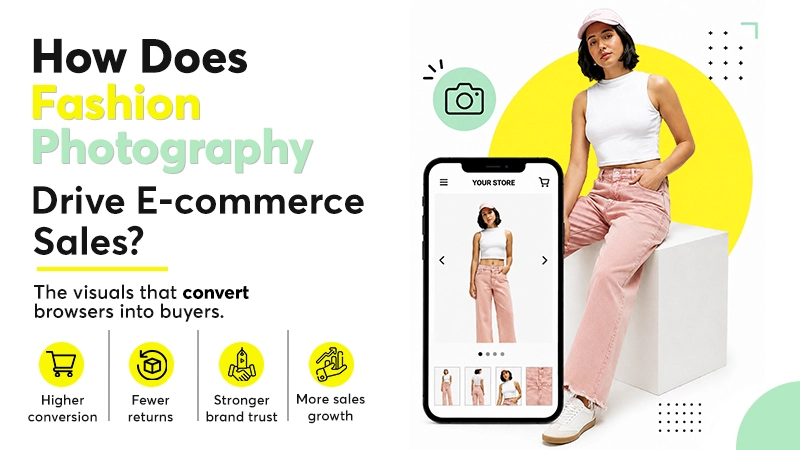
You've got a great product. A well-built store. Decent traffic. But sales aren't where they should be.
Before you rethink your ads or change your pricing, look at your product photos.
In e-commerce, your fashion photography images are your salespeople. It builds trust. They answer questions. They help buyers picture themselves wearing what you're selling without ever touching it.
About 75% of online shoppers say product photos directly influence whether they buy or not. Your fashion shoot isn't a cost. It's what converts browsers into buyers.
E-commerce fashion photography is the complete visual system that communicates fit, fabric, drape, and brand identity to a shopper who can't touch or try anything. It's not just product shots. It's the entire visual experience that either builds purchase confidence or destroys it before a word is read.
Fashion is the most visual product category in e-commerce. You can write 200 words about a dress and still not convey what a single well-lit fashion photography picture does in two seconds.
95.6% of fashion e-commerce brands use model photography. Seeing a garment on a body answers fit questions a flat image never can.
If your product's shown on a real model instead of a flat, lifeless product shot, conversion rates can climb by roughly 33% compared to weaker visuals. And we've all felt that letdown when what arrives doesn't quite match the picture; that gap alone drives about 22% of order returns.
Even small inconsistencies across your shots, such as mismatched lighting, odd angles, or a background that doesn't match the rest of your catalogue, harm consumers’ trust in the product.
So a proper fashion shoot isn't just a styling expense. It's what keeps returns down, keeps your brand's reputation intact, and turns a hesitant browser into a confident buyer.
I went through multiple reports and data points from ElectroIQ, GrabOn, and PixelPhant's product photography research, and this is what I'd definitely consider while planning a product photography shoot.
Not every shoot serves the same purpose. Here's how the main formats compare:
76.1% of fashion ecommerce brands use more than one photography style. Different formats answer different buyer questions. The brands converting best aren't choosing one; they're layering them strategically across every product page.
The numbers make one thing clear: how you shoot a product matters just as much as whether you shoot it well.
A shopper scrolls late at night, unsure she needs another jacket until one photo stops her: not the stitching, but a life she can picture herself in.
That's why 38.4% of fashion brands use lifestyle imagery. It answers "where does this belong in my life?" The best shots feel aspirational yet attainable, sparking instant recognition: that could be me.
73% of US ecommerce traffic is now mobile. On a small screen, your first image does all the heavy lifting instantly. If it's dark or low-resolution, shoppers scroll past.
Eye-tracking studies show 74% of mobile shoppers evaluate fashion photography pics before reading any description. On a phone screen, most of what shoppers see before they scroll is your product photo; everything else- the title, the price, the details- comes after. But what makes
If that first image doesn't do its job, nothing else on the page gets a chance to.
More than you probably have right now. A minimum of 5 to 7 images per SKU is the standard.
For fashion, that means front view, back view, detail shot, flat lay or ghost mannequin, lifestyle context, and a close-up of fit.
For hero products, add 360-degree views or video. 360-degree visuals increase time spent on product pages from 32% to 50%.
Choosing a photography partner isn't just about finding someone with a good camera. The right team should understand how fashion products are bought online. And accordingly, create visuals that help shoppers make confident decisions.
A good studio fashion photography setup goes beyond producing attractive images. It should deliver consistency, accuracy, and the flexibility to scale as your catalogue grows.
Before making a decision, review their portfolio beyond a few standout images. Look at complete catalogues, ask for client references, and evaluate how consistently they maintain quality across different product categories. Also consider these key factors:
The right photography partner should work as an extension of your team, helping every collection look consistent, strengthen your brand identity, and perform better across every sales channel.
Here's what it all comes down to: great fashion photography isn't a nice-to-have. It's what stands between a shopper's doubt and their decision to buy.
Whether it's a studio that understands your brand or a lifestyle shot that helps shoppers picture themselves using your product, every image has a purpose. Even a simple flat lay can highlight texture, fit, and important details. Together, these visuals start selling your product long before your copy gets a chance to.
The numbers support this. 90% of online shoppers say photo quality is the biggest factor in their buying decision. That's not a statistic to ignore. It shows that photography isn't just a creative asset; it's part of your revenue strategy.
Clear, consistent images help shoppers understand exactly what they're buying. That builds confidence, improves conversions, and reduces unnecessary returns.
So, don't treat your next fashion shoot as another task on the checklist. Treat it as an investment in how your brand is seen, trusted, and remembered. Because when your visuals do their job well, every other part of your e-commerce journey becomes stronger.
Tell us what you're working on and we'll get back to you with ideas and next steps.


Fashion photography is the visual system that communicates fit, fabric, and brand identity to online shoppers. It matters because 75% of shoppers say product photos directly influence purchase decisions, and 90% say photo quality is the single most important factor in buying online.
Model photography delivers the highest impact on conversion. Ghost mannequin and flat lay work well for structure and detail. Lifestyle fashion creative photography builds an emotional connection. 360-degree views and video significantly lift conversion and reduce returns. Most top brands use multiple formats per product rather than relying on a single format.
A minimum of 5-7 images per SKU covering front, back, detail, lifestyle, and fit close-up. When ASOS increased from six to twelve images per product, mobile conversion rose 18% in 90 days and generated an estimated £47 million in additional quarterly revenue from that single change.
22% of online returns happen because the delivered product looks different from the images shown. Accurate, multi-angle fashion photography directly reduces return rates by setting realistic expectations before purchase, protecting both revenue and long-term customer trust.
Look for consistency across large catalogues, platform-specific image knowledge, strong post-production quality, fast turnaround, and the ability to produce multiple shoot types, models, flat lay, ghost mannequin, and video under one roof without handoffs between studios.
ODN provides end-to-end fashion photography, models, flat lay, ghost mannequin, and video under one roof, ensuring consistent quality across large catalogues. With fast turnaround and platform-specific formatting, ODN helps brands boost conversions and cut returns without juggling multiple vendors.


.png)


