

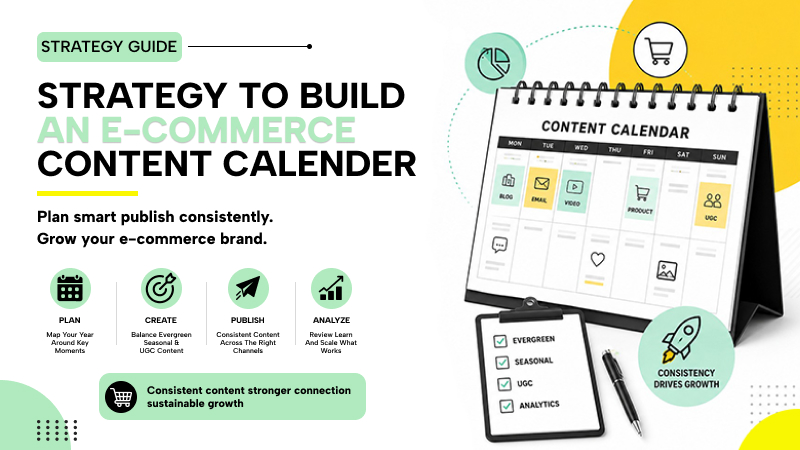
Great content goes out in one week. Nothing next. A flash of activity around a sale, then silence. And the algorithm, whether it's Google, Instagram, or Amazon, punishes inconsistency just as fast as it rewards consistency.
The market is growing fast. But so is the competition. Brands that show up consistently win the customer relationship before the sale begins. An e-commerce content calendar is what makes that consistency possible, and this blog shows you exactly how to build one.
An e-commerce content calendar is a planned schedule of everything your brand will publish across channels, such as blog, email, social, video, and marketplace.
It's not just a scheduling tool. It's your editorial backbone. It aligns your content with seasonal moments, keeps your team organised, and ensures nothing falls through the gaps between campaigns and regular publishing commitments.
A strong e-commerce content calendar balances three content types. Get this balance right, and your content stops feeling random; it starts feeling like a brand. Let’s have a look at them.
Evergreen content answers the questions buyers ask before, during, and after purchase. Content such as how-to guides, buying guides, product comparison posts, FAQ pages, and care instruction articles don’t expire.
A well-written guide published today can rank on Google and drive traffic for years. Prioritise evergreen content in your calendar. It's the foundation everything else builds on. How-to articles (76%) and lists (54%) rank as the most popular blogging formats, according to Orbit Media's survey
This is the content tied to peak seasons, sales events, product launches, and promotional moments.
Key 2026 ecommerce moments include Prime Day in late March, Black Friday on November 28, and the full Q4 festive season.
Each needs content planned at least 4,6 weeks ahead. Brands that prepare content before peak seasons consistently outperform those that react to them.
Around 37% of consumers turn to social media first for product reviews and recommendations. User-generated content, such as customer photos, reviews, and video testimonials, is now one of the highest-converting content formats in ecommerce.
Your content calendar for e-commerce should include regular slots for amplifying UGC across social, email, and product pages. It's low-cost, high-trust, and increasingly what shoppers expect before buying.
Now that you've understood the significance of having a content calendar, here are the key steps that will help you create a realistic one for your team.
Map your full year before filling in content. Identify peak seasons, promotional moments, new product launches, and brand milestones. These anchor points shape everything else. Work backwards from each moment. If Black Friday is November 28, your content push starts in early October.
Email sequences, social posts, blog content, and product page updates all need to be ready before the window opens.
You don't need to be everywhere. You need to be consistent with where your buyers actually are. For instance, most Gen Z consumers use social platforms to find their next purchase. If that's your audience, your e-commerce content calendar needs to weigh social heavily.
Fewer channels done consistently will always beat all channels done poorly. Pick based on where your audience spends time, not where every brand (especially your competitors) seems to be.
Organise your calendar around monthly themes that align with what your buyers care about. A fashion brand might theme January around "New Year, New Wardrobe." A home goods brand might theme March around spring cleaning. A fitness brand might theme July around summer goals.
These themes give every piece of content context and make your output feel connected rather than random and disconnected.
Here's a sustainable baseline for most e-commerce brands
Consistency matters more than frequency. A schedule built around production capacity, launch cycles, and seasonal demand usually performs better than an ambitious calendar that becomes difficult to sustain.
Batching and scheduling are what maintain consistency without overwhelm. Dedicate specific time each week or month to creating content in bulk. Then schedule it across channels in advance.
It’ll take some amount of discipline to commit to the schedule and protect that production time from other priorities.
A content calendar without a performance review loop is just a schedule. The review is what makes it a strategy.
Check which blog posts drove the most traffic, emails with the highest open rates, social posts with the most engagement, and double down on what works. Cut what doesn't. Let data guide your next quarter's ecommerce content calendar, not gut feel alone.
But hey! You’re allowed to explore your creativity and experiment with fresh ideas as well. Be strategic but don’t let your creativity be lost in analytics only!
We've discussed the strategy. Now let's go through the common mistakes you must avoid to ensure a smooth execution.
An e-commerce content strategy without a calendar is just good intentions. The calendar is what turns intention into consistent action. And consistent action is what compounds into traffic, trust, and sales over time.
Build your e-commerce content calendar around your customers' year, not just your promotional one. Balance evergreen content with seasonal campaigns and community-driven content.
Publish consistently and always review the performance. Treat your content calendar as the most important operational document in your marketing team. That's how ecommerce brands build growth that doesn't stop when the ad spend does.
Tell us what you're working on and we'll get back to you with ideas and next steps.


An e-commerce content calendar is a planned schedule of all content your brand will publish across channels, such as blog, email, social, video, and marketplace. It ensures consistent publishing, aligns content with seasonal moments, and keeps your team organised and on track throughout the year.
Plan at least 4,6 weeks for campaign content tied to peak seasons and 2 weeks ahead for regular social and email content. For major events like Black Friday or Prime Day, planning should begin 8,10 weeks in advance to give content time to rank and build momentum.
Consistency matters more than frequency. Two quality blog posts per month, one to two emails per week, and four to five social posts per week is a sustainable starting point. Scale up once your workflow is consistent, not before. An ambitious schedule you can't maintain is worse than a modest one you can.
Your content strategy defines what you want to achieve, who you're speaking to, and what types of content you'll create. Your content calendar is the operational plan that turns that strategy into scheduled, published content. You need both a strategy to set the direction and a calendar to make it happen consistently.
The answer depends on content volume, production capacity, and growth goals. Brands managing multiple channels, seasonal campaigns, and large content pipelines often work with ODN’s ecommerce content solutions to streamline planning, content production, and execution while maintaining consistency at scale.
High-growth brands usually reduce content pressure by planning monthly themes, batching production, repurposing content across channels, and building repeatable workflows. The goal is not creating more content but creating content more systematically.

.png)


