

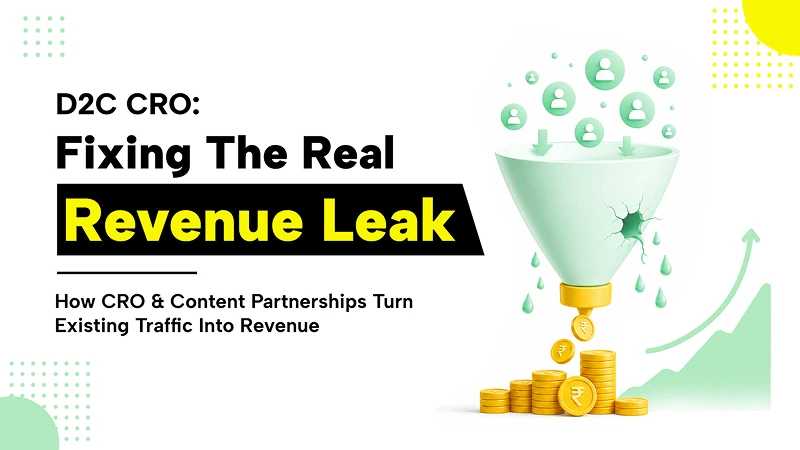
You're spending lakhs on Meta ads. Traffic is coming in. But sales feel stuck, and nobody can quite explain why.
If this sounds familiar, you're not alone. And you're probably looking in the wrong place for the answer.
Many D2C brands plateau despite healthy traffic. It's a common pattern, and it's frustrating. The problem usually isn't the ads. It's what happens after the click.
This blog explores exactly that. We'll look at why conversion rate optimisation (CRO) remains one of the most underused growth levers in ecommerce. And how performance agencies and content partners are teaming up to fix the customer journey, where most of the revenue is being lost.
Whether you're a D2C founder, growth marketer, or performance agency, understanding this shift can help you extract more value from the traffic you're already paying for.
Most D2C brands in 2026 have a conversion problem. Traffic is there, but quality leads are missing.
Paid media continues to become more expensive. Competition on Meta, Google, and marketplaces is intensifying. Yet the default response to flat sales is often the same: increase the budget.
That approach is becoming increasingly difficult to sustain.
The average e-commerce conversion rate globally sits around 2.86%, while many Indian D2C brands operate between 1.5% and 2%. The gap between those numbers represents revenue that already exists within current traffic volumes but remains unrealised.
Before discussing solutions, let’s understand the math.
Imagine your D2C store receives 50,000 visitors each month and converts at 1.2%. That results in 600 orders.
If conversion improves to 2.4%, you generate 1,200 orders from the same traffic volume.
No additional media spend.
No increase in customer acquisition costs.
Just a more effective customer journey.
Even a modest improvement from 2% to 2.5% can increase revenue by 25% from existing traffic. This is why mature ecommerce brands treat conversion optimisation as a profit lever rather than a marketing experiment.
Performance marketing agencies excel at driving qualified traffic through advertising, targeting, bidding strategies, and creative testing.
However, paid traffic serves another purpose: it reveals weaknesses in the buying journey.
When conversion rates disappoint, many brands blame targeting, creative performance, or platform changes. In reality, the issue often lies further down the funnel.
Common friction points include:
Increasing traffic without addressing these issues often amplifies inefficiencies rather than solving them.
The strongest D2C brands are focusing on four content and experience layers that directly influence purchase decisions.
Product Detail Pages That Remove Buying Friction
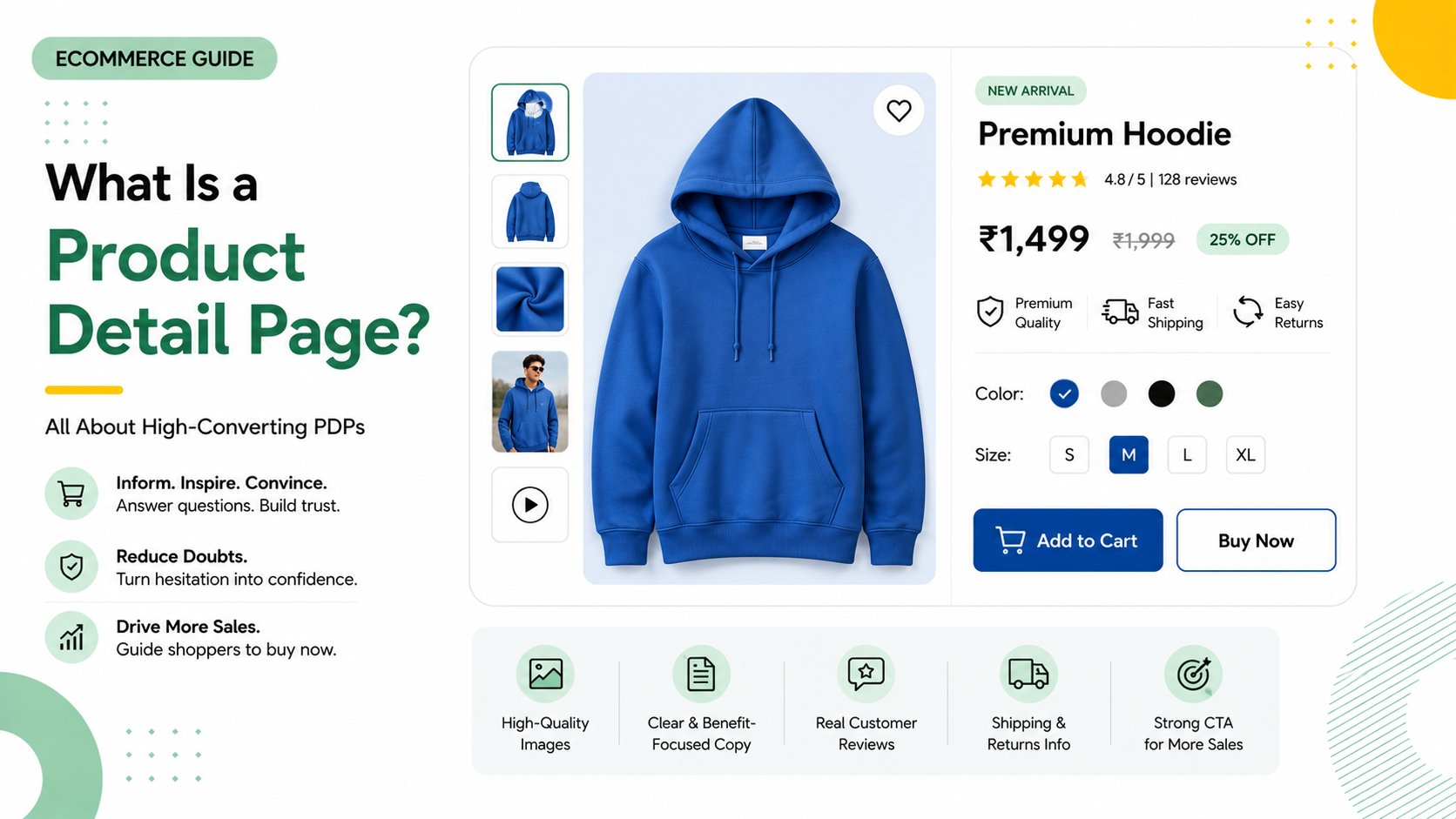
Product detail pages are often the most important conversion asset in the e-commerce journey.
Many shoppers arrive directly on a product page after clicking an ad. Within seconds, they decide whether to continue exploring or leave.
Effective PDPs answer key customer questions immediately through:
The goal is simple: reduce uncertainty before it becomes abandonment.
On marketplaces such as Amazon and Flipkart, shoppers frequently compare multiple products before purchasing.
A+ content and brand storefronts help brands stand out by providing:
Rather than relying solely on product specifications, brands can create a richer buying experience that supports faster decision-making.
One of the most overlooked conversion challenges is message mismatch.
If an ad highlights convenience, affordability, or a specific product benefit, shoppers expect to see that same value proposition immediately after clicking.
When landing pages fail to reinforce the promise made in the ad, confidence drops and bounce rates rise.
Aligning ad messaging, product page content, visuals, and offers creates a smoother path from click to conversion.
Today's e-commerce shoppers engage with multiple content formats before purchasing.
Product images, videos, infographics, A+ modules, storefronts, comparison charts, creator content, and reviews all contribute to buying confidence.
Brands that maintain consistency across these assets create a more cohesive shopping experience.
Brands that don't often leave customers searching for answers that should already be available on the page.
Conversion optimisation is often associated with A/B testing, UX improvements, and checkout enhancements.
While those areas matter, content remains one of the most influential factors in purchase decisions.
Strong content helps shoppers:
This is especially important for e-commerce, where customers cannot physically interact with the product before buying.
As acquisition costs rise, the quality of product content increasingly determines whether traffic converts into revenue. This makes e-commerce product content strategies a significant part of long-term marketplace growth.
Many agencies are now expanding beyond traffic acquisition by collaborating with specialised content partners.
The model is straightforward :
This creates a closed-loop system where advertising drives visitors and content helpsconvert them.
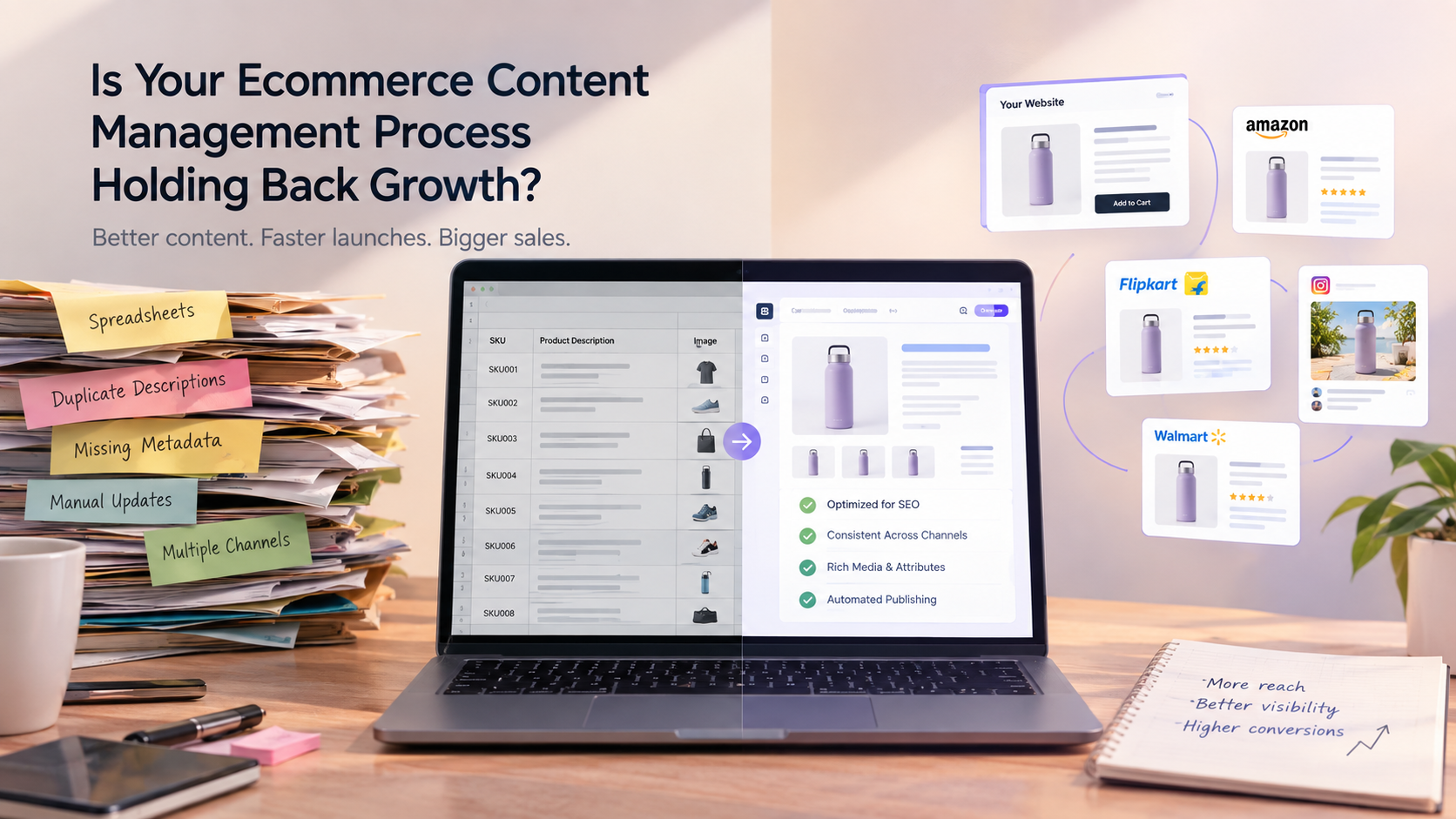
ODN operates as a specialised e-commerce content agency that supports the content assets influencing conversion across marketplaces and D2C platforms.
Working with over 200 brands, ODN helps businesses create and scale:
Its AI-powered workflows and production infrastructure help brands manage content across large catalogues while maintaining consistency, compliance, and speed.
For performance agencies, this means access to a scalable content engine that supports campaign goals without requiring internal teams to expand creative production capabilities.
Unlike paid media, which requires ongoing investment to maintain performance, conversion improvements continue to create value over time.
Better content can:
This is why many mature D2C brands view CRO as an ongoing operational discipline rather than a one-time project.
When acquisition and content work together, every marketing rupee becomes more productive.
India's D2C ecosystem continues to grow rapidly, but growth is becoming more expensive.
The brands creating sustainable advantages are not simply buying more traffic. They are improving what happens after the click.
Product pages, visual content, brand storytelling, message consistency, and marketplace experiences all play a critical role in whether a visitor becomes a customer. For performance agencies, partnering with specialised content experts creates an opportunity to deliver stronger outcomes without relying solely on increased ad spend. And for brands, it means turning existing traffic into greater revenue before investing more into acquisition
Tell us what you're working on and we'll get back to you with ideas and next steps.


Product pages provide the information shoppers need to evaluate a product. Strong copy, imagery, videos, reviews, and infographics help reduce uncertainty and encourage purchases.
Yes. Improving product content, visual assets, and customer education can help more visitors convert without requiring additional traffic acquisition.
Agencies should look for partners who can scale content production, maintain marketplace compliance, ensure brand consistency, and align assets with campaign messaging.
Product photography, lifestyle imagery, videos, A+ content, comparison charts, infographics, reviews, and brand storefronts are among the most influential content assets for ecommerce conversions.
ODN supports the content layer of CRO by producing and managing the visual and informational assets that influence customer decisions across marketplaces and D2C storefronts.
More traffic only increases visibility. If product pages, visuals, messaging, and trust signals do not support purchase decisions, brands simply scale drop-offs. Conversion growth happens when acquisition and content work together across the customer journey.

.png)


