

Audience targeting is no longer the competitive advantage it once was. Platforms like Meta and Google have automated much of the optimisation process, giving advertisers access to similar targeting capabilities.
As a result, creativity has become one of the biggest drivers of campaign performance. According to Meta and Nielsen research, creative quality significantly influences engagement, conversions, and overall advertising effectiveness.
The challenge is that campaign optimisation happens in real time, while creative production often moves much more slowly. As testing demands increase, many performance marketing companies struggle to produce enough creative variations to keep campaigns fresh and scalable.
This is why more agencies are partnering with specialised content production teams. By accelerating creative development and reducing production bottlenecks, these partnerships help performance teams test faster, combat creative fatigue, and scale winning campaigns more efficiently.
A few years ago, marketers could gain a competitive advantage through audience segmentation alone. Today, platforms have made targeting significantly more accessible through automation and machine learning.
When multiple advertisers can access similar targeting capabilities, creative becomes the primary differentiator.
The ad itself now determines whether someone:
This shift has created a new reality for performance marketers. Now winning campaigns function through a steady supply of relevant, engaging, and platform-specific creative assets.
In fact, many D2C brands are now investing more in creative content than ads. This is because creative quality increasingly determines campaign performance.
Most agencies have become highly efficient at launching, monitoring, and optimising campaigns.
Creative production, however, often operates on a completely different timeline.
Common challenges include:
As campaign testing velocity increases, these bottlenecks become more visible.
A performance marketer may identify three winning messaging angles today but still wait weeks for the next set of creative assets to be produced.
Even the best-performing ad eventually loses effectiveness.
When audiences repeatedly see the same creative, engagement declines, and acquisition costs often rise. This phenomenon, commonly known as creative fatigue, affects nearly every scaled advertising campaign.
Symptoms typically include:
Meta actively recommends regular creative refreshes to maintain campaign efficiency and audience engagement.
For brands running always-on advertising campaigns, creative renewal is no longer optional. It is a core operational requirement.
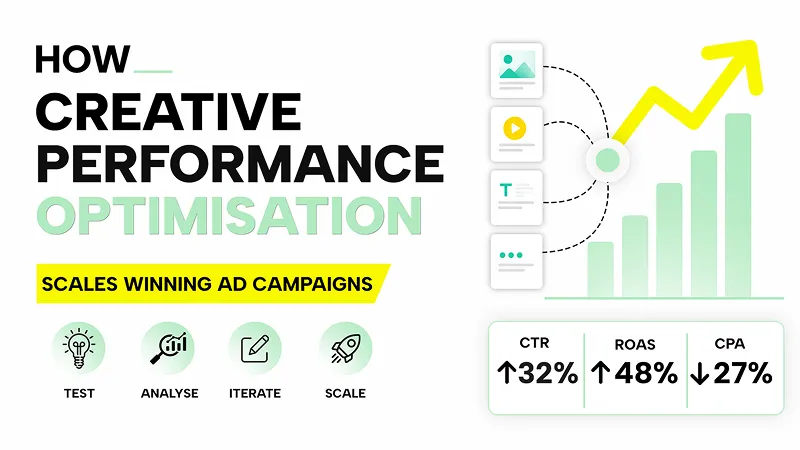
Creative performance optimisation is not simply about designing better ads.
It is the process of using campaign data to continuously improve creative assets through structured testing and iteration.
Performance teams typically evaluate metrics such as:
The objective is straightforward: learn from performance data and apply those insights to future creative production.
Rather than guessing what might work, teams use evidence to guide the next round of creative development.
One of the biggest misconceptions in performance marketing is the belief that a single high-performing creative can sustain growth indefinitely.
In reality, successful brands build systems rather than relying on individual campaigns.
Instead of searching for one perfect ad, they continuously test:
This approach allows brands to discover new winners before existing creatives lose momentum.
Brands such as Gymshark and Nykaa have demonstrated how ongoing creative experimentation can support sustained growth across highly competitive markets.
High-performing teams typically operate within a continuous feedback loop.
The process looks something like this:
Launch Multiple Variations
Instead of relying on one creative concept, teams test several formats, messages, and visual approaches simultaneously.
Analyse Performance Signals
Data reveals which creatives generate stronger engagement, clicks, and conversions.
Translate Insights Into New Assets
Winning elements are incorporated into the next generation of creative production.
Scale What Works
The strongest-performing assets receive additional investment while weaker variations are retired.
This process creates a cycle of continuous improvement rather than periodic campaign overhauls.
Most performance marketing companies understand what needs to be tested.
The challenge is producing enough assets quickly enough to support that testing strategy. This is where a specialised e-commerce content agency creates value.
They help performance teams:
For agencies managing multiple clients, this additional production capacity can significantly improve testing velocity without expanding internal creative teams.
Creative speed is increasingly tied to campaign performance.
When teams can quickly convert insights into new assets, they can:
As acquisition costs continue to rise across major platforms, the ability to produce and deploy creative assets quickly has become a meaningful competitive advantage.
Performance marketing is no longer just about reaching the right audience.
It is about continuously delivering relevant creative experiences that resonate with that audience.
The brands and agencies seeing the strongest results today are not necessarily spending more. They are testing more, learning faster, and applying proven ecommerce product content strategies that allow creative insights to move quickly from performance data to production.
As creativity becomes increasingly central to campaign success, the partnership between performance marketing teams and specialised content production providers is becoming less of an advantage and more of a necessity.
Tell us what you're working on and we'll get back to you with ideas and next steps.


Creative performance optimisation is the process of analysing campaign data and using those insights to improve ad creatives through ongoing testing, iteration, and refinement.
Creative is often the first thing a customer notices. Strong visuals, messaging, and formats can significantly influence engagement, clicks, and conversions, making creativity a major driver of campaign performance.
Creative fatigue occurs when audiences repeatedly see the same ad. Over time, engagement decreases, click-through rates decline, and acquisition costs often increase.
Creative production partners help agencies scale content creation, generate multiple creative variations, maintain consistency, and support faster testing cycles without significantly increasing internal production resources.
Creative production partners help agencies scale content creation, generate multiple creative variations, maintain consistency, and support faster testing cycles without significantly increasing internal production resources.
Brands should look for partners that can produce assets at scale, maintain quality across channels, support multiple content formats, and adapt quickly to performance insights and changing campaign requirements.


.png)


