

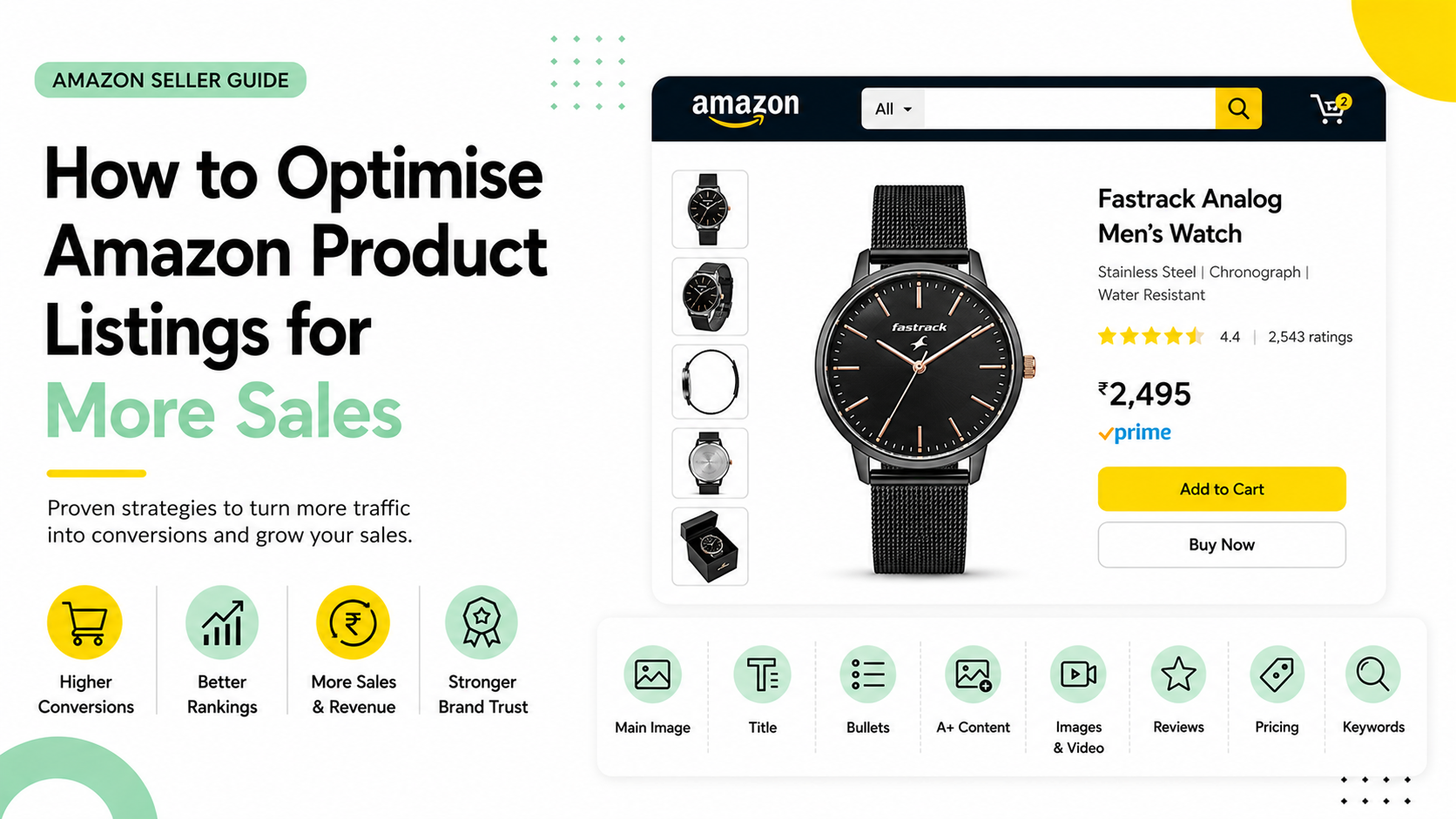
Your product is live. Traffic is coming in. But sales don't match the visits.
A good Amazon conversion rate sits between 10–15%. If yours is below that, you're not just missing sales; you're missing ranking signals. Amazon's algorithm directly rewards listings that convert well by showing them to more shoppers. Low conversion hurts visibility. Low visibility hurts conversion. It compounds in the wrong direction.
This blog covers eight proven Amazon product listing optimisation strategies from your main image to backend keywords, each backed by data and directly tied to more units sold from the traffic you already have.
Before getting into Amazon product listing optimisation, know where you stand. In Seller Central, go to Business Reports and check Unit Session Percentage at the ASIN level.
This shows units sold per session, the most accurate proxy for conversion rate on Amazon.
Check Brand Analytics too. Search Query Performance shows where shoppers drop off. Know your number first. Then start moving it.
Once you know the basics, here's where the actual work happens. Each lever below builds on the one before it. A click earned by your image only converts if your title, bullets, and content follow through.
Think of it as a chain: break one link, and the shopper drops off before reaching the next.
Your main image is the only thing shoppers see before deciding whether to click. And on mobile, that decision takes under two seconds. A kitchen brand testing a plain product shot against one showing the blender mid-pour saw clicks jump noticeably.
Get this click first; everything else on the page only matters once someone arrives.
That click only pays off if your title confirms the shopper clicked the right thing. Lead with your primary keyword, follow with your biggest differentiator.
A supplement brand rewriting "Vitamin D3 5000IU, 120 Capsules" to lead with "Non-GMO Vitamin D3" saw stronger click-through, because the title now answers "why this one" before the shopper even scrolls.
A strong title creates curiosity; bullets are where that curiosity gets resolved or lost. Lead with the outcome, not the spec. A backpack brand rewriting "600D polyester fabric" as "Survives daily commutes without fraying" saw hesitation drop, because the bullet answers the exact doubt a scanning shopper was about to leave with.
Bullets handle quick objections; A+ Content handles the bigger ones bullets can't fit. A skincare brand added a comparison module showing their formula against three alternatives and saw fewer shoppers bounce to compare elsewhere. If you're Brand Registry-enrolled and skipping A+ Content, you're leaving that deeper trust-building step completely unused.
Copy builds trust; visuals remove the doubts words can't fully resolve. A furniture brand added a scale-reference image and a 30-second assembly video, and returns dropped measurably. Each image should kill one specific uncertainty: size, material, use-case, so by the final photo, nothing is left unanswered.
Everything so far is the brand talking; reviews are where other buyers confirm it's true. A kitchenware listing with 50 reviews at 4.7 stars consistently outsold one with 10 reviews at 4.9, because volume signals real purchases. Respond to negative reviews publicly; it shows future shoppers you stand behind the product.
By this point, the shopper has built a mental value estimate; pricing either confirms it or breaks it. A skincare brand priced just below a bestselling competitor saw conversion rise, since the listing had already justified the value; the price simply closed the decision the content had been building toward.
Every lever above only works if shoppers actually find the listing first. Backend search terms are invisible but drive indexing. A pet supply brand added misspellings and regional terms like "puppy lead" alongside "puppy leash," and traffic rose, proof that discoverability is the foundation the other seven levers depend on.
Here's how each listing element maps to conversion impact and priority:
If you're managing a large catalogue, launching in a competitive category, or running paid traffic to listings that aren't converting, Amazon product listing optimisation services from a specialist team can move the needle significantly faster than internal trial and error. Specialists bring keyword research tools, conversion data across categories, A+ content production, and testing frameworks that take months to build in-house.
Amazon delivers conversion rates of 10–15% for well-optimised listings. If you're below that benchmark, the gap is almost always in your listing content, not your product, not your pricing, and not your ads. Start with your main image.
Audit your title. Strengthen your bullet points. Add A+ Content. Build your review strategy. Track the Unit Session Percentage every week. Amazon product listing optimisation isn't a one-time task.
It's the ongoing system that keeps your conversion rate above the category average and keeps Amazon showing your product to more shoppers as a result.
Tell us what you're working on and we'll get back to you with ideas and next steps.


A good Amazon conversion rate is 10–15% for most product categories. Amazon's high-intent traffic means well-optimised listings consistently outperform the 2-3% averages seen on typical e-commerce websites. If you're below 10%, your listing content is almost always the primary issue worth addressing first.
Amazon's algorithm rewards listings that convert well by showing them to more shoppers. A higher conversion rate signals that your listing efficiently turns traffic into revenue, which is Amazon's primary goal. Better conversion directly improves organic ranking, which drives more traffic, which improves conversion further.
Your main product image. It determines whether a shopper clicks your listing in the first place. Without the click, nothing else matters. After that, your title, bullet points, review count, and A+ Content have the most direct and measurable impact on conversion rate.
In Seller Central, go to Business Reports and look at Unit Session Percentage at the ASIN level. This shows units sold divided by sessions, the most accurate proxy for conversion rate on Amazon. Check both parent and child ASIN levels for a complete picture of listing performance.
If you're managing a large SKU catalogue, operating in a competitive category, or running paid traffic to listings that aren't converting, a professional service typically pays for itself quickly. Specialists bring keyword data, conversion frameworks, and A+ content production that would take significant time and testing to build internally.
We create conversion-focused Amazon listings with optimized titles, bullet points, A+ Content, and keyword-rich descriptions, helping brands improve discoverability, shopper engagement, and conversions across their product catalog.

.png)


